
Table of Contents
ToggleVirtual reality trends 2026 point toward a major shift in how people interact with digital environments. Hardware is getting lighter. Software is getting smarter. And adoption is spreading far beyond gaming into healthcare, enterprise training, and social platforms.
The VR industry has moved past its early hype cycle. Companies are now shipping products that solve real problems for real users. In 2026, consumers and businesses alike will see meaningful improvements in comfort, accessibility, and practical applications.
This article breaks down the key virtual reality trends 2026 will bring. From next-generation headsets to AI-driven experiences, here’s what’s coming and why it matters.
Key Takeaways
- Virtual reality trends 2026 show headsets becoming lighter (under 400 grams) and more affordable ($200-300), removing major barriers to mainstream adoption.
- AI-powered VR experiences will generate entire worlds on demand and personalize environments based on user behavior and preferences.
- Social VR platforms now feature improved avatar technology with facial and body tracking, making virtual interactions feel more natural and human.
- Enterprise VR training delivers 75% higher retention rates than traditional methods, making it the fastest-growing segment in the industry.
- Healthcare applications like pain management, mental health therapy, and surgical training are gaining clinical validation and insurance coverage.
- Virtual reality trends 2026 signal a shift from early hype to practical, problem-solving applications across gaming, business, and medicine.
Lighter and More Affordable Headsets
Weight has always been VR’s biggest barrier to mainstream adoption. Nobody wants a heavy brick strapped to their face for hours. In 2026, that’s finally changing.
Major manufacturers are releasing headsets under 400 grams, roughly the weight of a baseball. Pancake lenses and improved display technology allow for slimmer profiles without sacrificing visual quality. Meta, Sony, and Apple have all signaled plans for lighter models, and smaller players are following suit.
Price drops are equally important. Entry-level standalone VR headsets will hit the $200-300 range in 2026. This brings virtual reality trends 2026 into reach for budget-conscious consumers who previously couldn’t justify the investment.
Battery life is improving too. Expect 3-4 hours of continuous use on mid-range devices, up from the 2-hour average seen in earlier generations. Some manufacturers are introducing hot-swappable battery packs, letting users extend sessions without interruption.
These hardware improvements matter because they remove friction. When a headset feels comfortable and costs less than a gaming console, more people will actually use it. That’s the foundation everything else builds on.
AI-Powered Immersive Experiences
Artificial intelligence is reshaping what’s possible inside virtual environments. In 2026, AI won’t just power NPCs, it’ll generate entire worlds on demand.
Procedural content generation has advanced significantly. AI systems can now create realistic landscapes, buildings, and objects in real time based on user preferences. Want a medieval castle? A cyberpunk city? The system builds it while you watch.
Voice interaction has become more natural. AI assistants inside VR respond to conversational speech rather than rigid commands. Users can ask questions, request changes to their environment, and receive contextually appropriate responses. This makes virtual reality trends 2026 feel less like using software and more like inhabiting a space.
Personalization is another major development. AI tracks user behavior to adjust difficulty levels, suggest content, and modify environments for comfort. Someone prone to motion sickness might see smoother transitions. A user who prefers exploration over combat gets different gameplay recommendations.
The combination of generative AI and VR creates experiences that weren’t possible two years ago. Each session can feel genuinely unique.
Social VR and the Metaverse Evolution
Remember when “metaverse” was everywhere in 2021 and 2022? The hype cooled, but the underlying technology kept developing. Social VR platforms are now delivering on some of those early promises.
Avatar technology has improved dramatically. Facial tracking captures micro-expressions. Body tracking reads gestures and posture. Conversations in social VR feel more like talking to actual people rather than cartoon characters floating in space.
Interoperability is slowly becoming reality. Standards bodies have made progress on allowing avatars and digital assets to move between platforms. Users won’t need separate identities for every VR social space they visit.
Virtual events are maturing as a category. Concerts, conferences, and meetups in VR offer experiences that video calls simply can’t match. Attendees can walk around, form small groups, and interact with shared objects. Several major music festivals plan VR companion events for 2026.
These virtual reality trends 2026 developments suggest social VR is finding its footing. It’s not replacing in-person interaction, but it’s becoming a legitimate alternative for certain use cases, especially when distance makes physical presence impossible.
Enterprise and Training Applications
Businesses have discovered that VR training works. Studies show retention rates 75% higher than traditional training methods for certain skills. In 2026, enterprise adoption is accelerating.
Manufacturing and logistics companies use VR to train workers on equipment operation before they touch real machinery. Mistakes in VR cost nothing. Mistakes on a factory floor cost money and sometimes lives.
Retail giants are deploying VR for customer service training. Employees practice handling difficult situations, angry customers, product returns, theft prevention, in realistic simulations. They build confidence before facing real-world scenarios.
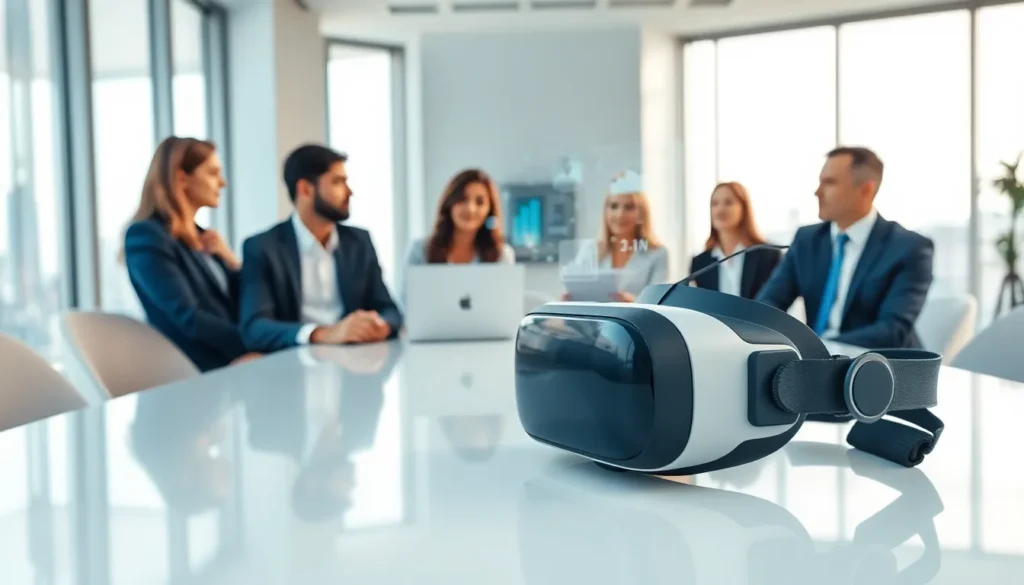
Remote collaboration tools have improved substantially. Teams can gather in virtual workspaces to review 3D models, manipulate data visualizations, and brainstorm ideas. This goes beyond video conferencing. Participants can literally walk around a proposed building design or examine a product prototype from every angle.
Virtual reality trends 2026 show enterprise as possibly the fastest-growing VR segment. When companies calculate ROI on reduced training costs, fewer accidents, and improved employee performance, the investment makes sense.
Healthcare and Therapeutic Uses
Healthcare has emerged as one of VR’s most promising application areas. Clinical evidence continues to mount for specific therapeutic uses.
Pain management is a standout success story. VR distraction therapy reduces the need for pain medication during certain procedures. Burn victims, dental patients, and people undergoing chemotherapy report significant pain reduction when immersed in calming virtual environments.
Mental health applications are expanding. Exposure therapy for phobias and PTSD has moved from research settings into clinical practice. Patients confront fears, heights, crowds, traumatic memories, in controlled virtual environments with a therapist guiding them.
Physical rehabilitation uses VR to make repetitive exercises more engaging. Stroke patients regain motor function through games that feel like play rather than work. The gamification element increases compliance with prescribed therapy routines.
Medical training benefits enormously from VR. Surgeons practice procedures on virtual patients. Medical students learn anatomy by exploring 3D body models they can manipulate. These virtual reality trends 2026 applications save real patients from being practice subjects.
Insurance companies are starting to cover VR-based treatments for approved conditions. That coverage signals healthcare’s confidence in VR’s therapeutic value.


